
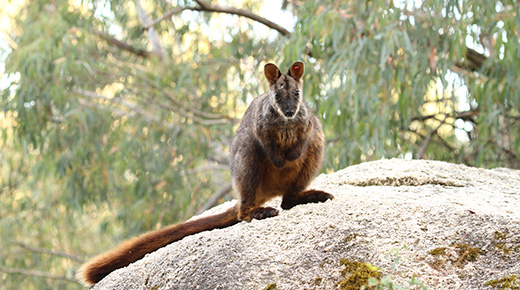
In 2018, the Brush-tailed Rock-wallaby was named the ACT mammal emblem. This species was last seen in the ACT in 1959 at Tidbinbilla Nature Reserve. Today Tidbinbilla is the only place in the ACT where Brush-tailed Rock-wallabies can be found in captivity and part of a breeding program designed to improve their genetic robustness.
The Brush-tailed Rock-wallaby has a characteristic, long, dark tail that is bushier towards the tip; a white cheek-stripe and a black stripe from its forehead to the back of its head. They are highly agile due to their compact, muscular build and their long tail that they use for balancing. Their feet have heavy padding and texture for their natural habitat that includes rocky escarpments, outcrops, caves and cliffs.
The Brush-tailed rock-wallaby occurs in fragmented populations roughly following the Great Dividing Range from southwest Queensland to western Victoria’s Grampians. They browse on vegetation such as grasses and forbs and the foliage of shrubs and trees.
The greatest impact to this species occurred over one hundred years ago when this species was hunted intensively for its fur and was seen as a pest to agriculturalists. Today, the greatest threat to this species is predation by the Red Fox, but other threats such as loss and fragmentation of habitat, loss of genetic diversity (for the southern population), weeds, competition with introduced herbivores such as goats and climate change are also making life difficult for these animals. The Brush-tailed Rock-wallaby is listed nationally as Vulnerable, however there is great variation in its status across its range.
The Brush-tailed Rock-wallaby can be separated into three genetically distinct groups, known as Evolutionary Significant Units (ESUs). These are the:
- Southern ESU found in Victoria, and originally extending as far north as the ACT
- Central ESU found in Hunter River, South East New South Wales and
- Northern ESU found in South East Queensland and North East New South Wales.
It is estimated there are less than 100 southern brush-tailed rock-wallabies remaining, and it is this critically endangered and unique population that Tidbinbilla has been working with to protect.
The southern Brush-tailed Rock-wallaby breeding program was established in 1996 when there was estimated to be less than 20 left in the wild. The initial focus was to build up a captive population as quickly as possible for re-introduction. To achieve this a technique called cross-fostering was used to rapidly accelerate breeding. The technique was highly successful – the captive population grew enough to allow for the first trial re-introduction in 2008 in the Grampians National Park. This method improved our understanding of reintroductions developing novel approaches for improving reintroduction success.
Subsequent genetic analyses of the southern population revealed that this population had lost so much genetic diversity that it was unlikely to survive in the long term without intervention. Tidbinbilla changed its approach to breeding – from quantity to quality. Instead of producing animals as quickly as possible a breeding program was designed and implemented to improve the genetic robustness of this population. The animals produced from this program are incredibly valuable and are the founders of another critical initiative undertaken by Tidbinbilla and the southern Brush-tailed Rock-wallaby Recovery Team, the establishment of a safe haven for this species, where the founders produced by the breeding program can thrive and reproduce safe from harm.
Since 2019, Tidbinbilla has been working hard, in the face of challenges such as Covid-19 and damaging floods, to create a safe haven for a self-sustaining population of the southern Brush-tailed Rock-wallaby. In June 2024, the 120-hectare predator-proof enclosure ‘Jedbinbilla Safe Haven’ was completed. The safe haven will house at least 100 individuals, allowing natural processes such as foraging and choosing a mate, and importantly, in a setting safe from foxes and other threats. This project was made possible after receiving a funding support from our partners Zoos Victoria, Prague Zoo, and the Commonwealth Department of Climate Change, Energy, the Environment and Water.
The animals within the safe haven not only provide an insurance population but also a source of genetically robust animals for conservation translocations, including getting this species back in the wild where it belongs.
As part of the recovery program, Tidbinbilla is partners with the southern Brush-tailed Rock-Wallaby Recovery Team, Zoos Victoria, Mount Rothwell Biodiversity Centre, the Victorian Department Environment, Energy, Climate Change and Water, Adelaide Zoo, and NSW Department of Environment and Heritage.
You can read more about the Brush-tailed Rock-wallaby and other threatened species in the Threatened Species listing.